- Sep 16
How to Regulate Your Nervous System: A Guide for the Whole Family
- 0 comments
Ask a child to calm down and watch what happens. Usually, nothing good. The instruction lands on top of a nervous system that's already flooded, and flooded systems don't take instructions well. Adults aren't so different. Tell yourself to relax in the middle of a stressful moment, and more often than not, it won’t get you very far.
After twenty years of working with children and the families raising them, I've come to see nervous system regulation as one of the most useful concepts to know about. While it may sound abstract or clinical, in practice, it's neither. It's a physical skill, and like any physical skill, it can be built.
What "Regulating Your Nervous System" Actually Means
Your autonomic nervous system runs constantly in the background, adjusting your body to whatever situation you're in. Research on the autonomic nervous system describes this as a set of physiological states rather than a single on-off switch (Porges, 2007). Broadly, you move between three:
Activated. Heart rate up, breathing shallow, muscles ready to act. Useful for a genuine threat, less useful for a spelling test!
Shut down. Withdrawn, numb, hard to reach. The body's way of conserving energy when a situation feels too overwhelming to fight or escape.
Regulated. Steady. Able to think, connect, and respond rather than react.
Regulation doesn't mean living permanently in that third state. It means being able to move through activation or shutdown and find your way back to steady ground, again and again, over the course of an ordinary day.
Your child may already be regulating themselves many times a day. The ability to ask for help is a form of regulation. So when your child comes and says, “I hurt myself; can you kiss it?”—that’s an example of regulation. When your school-aged child can verbalize feelings or ask for help to calm down, that is also self-regulation. The ability to self-regulate is a huge step in a child’s growth and development.
Why Telling Someone to Calm Down (Usually) Doesn't Work
A dysregulated nervous system is a physical state, not a decision. You cannot think your way out of a physical state with a verbal instruction. That's true for a five-year-old mid-tantrum, and equally true for the adult standing over him.
So often, parents will describe their child’s meltdown as defiance or manipulation, when it may instead be a nervous system that has tipped past its capacity. The behavior often looks willful, but not so the physiology behind it.
Of course, this doesn’t excuse the behavior or remove the need for boundaries. But what it does mean is addressing the state before addressing the behavior. A child who is flooded cannot hear you.
Co-Regulation: Where Regulation Really Begins
Here’s what's important to know: children don't learn to self-regulate by being told to. They learn it by borrowing a calm nervous system until they can grow one of their own.
Researchers call this co-regulation, and the evidence for it starts in infancy. When a baby cries and is held by its caregiver with a steady heartbeat, the baby's heartbeat also calms. Studies on parent-infant interaction show that a caregiver's physiological state and an infant's own regulatory capacity develop in tandem, shaped by countless small, synchronized exchanges over time (Feldman, 2007). That pattern doesn't end in infancy. A ten-year-old still reads your body before your words: your breathing, your posture, the tightness in your voice.
Your own regulation, in other words, is the foundation on which your child's regulation gets built. When you're steady, you're offering a nervous system for your child to borrow. When you're flooded too, there's nothing calm left in the room for either of you to draw on.
Building Your Own Regulation Toolkit
You cannot pour from a depleted nervous system. Chronic, unaddressed stress carries a real physiological cost. Long-term research on stress physiology shows that repeated activation without adequate recovery wears on the body over time (McEwen, 1998). Regulation tools aren't a luxury. They're maintenance.
Here are a few that you can easily incorporate:
Slow, extended exhales. A longer exhale than inhale signals safety to your nervous system. Four seconds in, six seconds out, repeated five or six times, shifts most people out of a mild activation state.
Movement with resistance. Pushing against a wall, carrying something heavy, or taking a brisk walk gives excess activation somewhere to go, rather than leaving it trapped in the body.
A grounding object or sensation. Cold water on your wrists, a textured object in your pocket, feet pressed firmly into the floor. Small sensory anchors pull attention back into the present.
And of course, all the tips suggested below for children work great for adults too 🙂
The trick is to use one or two simple tools consistently, rather than building an elaborate system you rarely reach for.
Helping Your Child Build Theirs
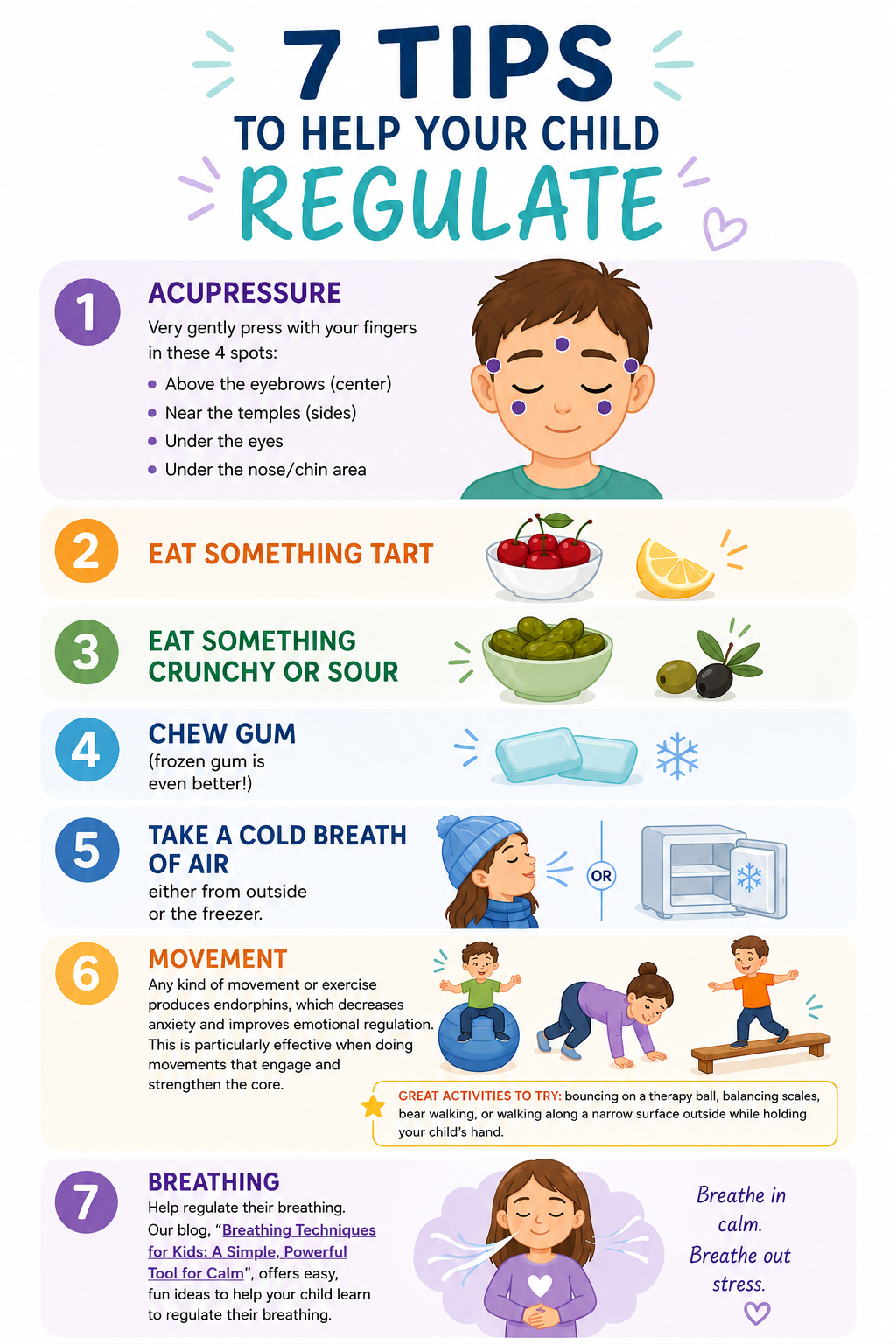
Here are 7 tips to help your child self-regulate that work for most ages.
1. Acupressure. Very gently press with your fingers on the middle of the eyebrows, then on the sides of the eyes, and finally under the eyes. Under the eyes are often found to be the most calming.
2. Eat something tart, e.g., cherries
3. Eat something crunchy or sour, e.g., pickles or olives
4. Chew gum (frozen gum is even better!)
5. Take a cold breath of air, either from outside or the freezer.
6. Movement. Any kind of movement or exercise produces endorphins (a type of hormone), which decreases anxiety and improves emotional regulation. This is particularly effective when doing movements that engage and strengthen the core.
A great activity to do: if you have a ball that’s at least the size of the child’s belly, have them sit on it and get them bouncing up and down to a rhythm. Balancing scales, bear walking, or even walking along a narrow surface outside while holding your child’s hand are other great options.
7. Help regulate their breathing. Our blog, "Breathing Techniques for Kids: A Simple, Powerful Tool for Calm" , offers easy, fun ideas to help your child learn to regulate their breathing.
An activity kids love is giving them balloons and letting them blow one up. If your child is small, squat down behind them; otherwise, just standing behind them is perfect. Place both hands on their last few ribs on both sides of the rib cage. Your child will deeply exhale in order to blow up their balloon, and as they do, press in firmly on the ribcage using your palms, not your fingertips. When they pause from blowing and take a deep breath, release your hands, so they sit lightly on their ribcage. If possible, repeat several times until they have blown up a couple of balloons.
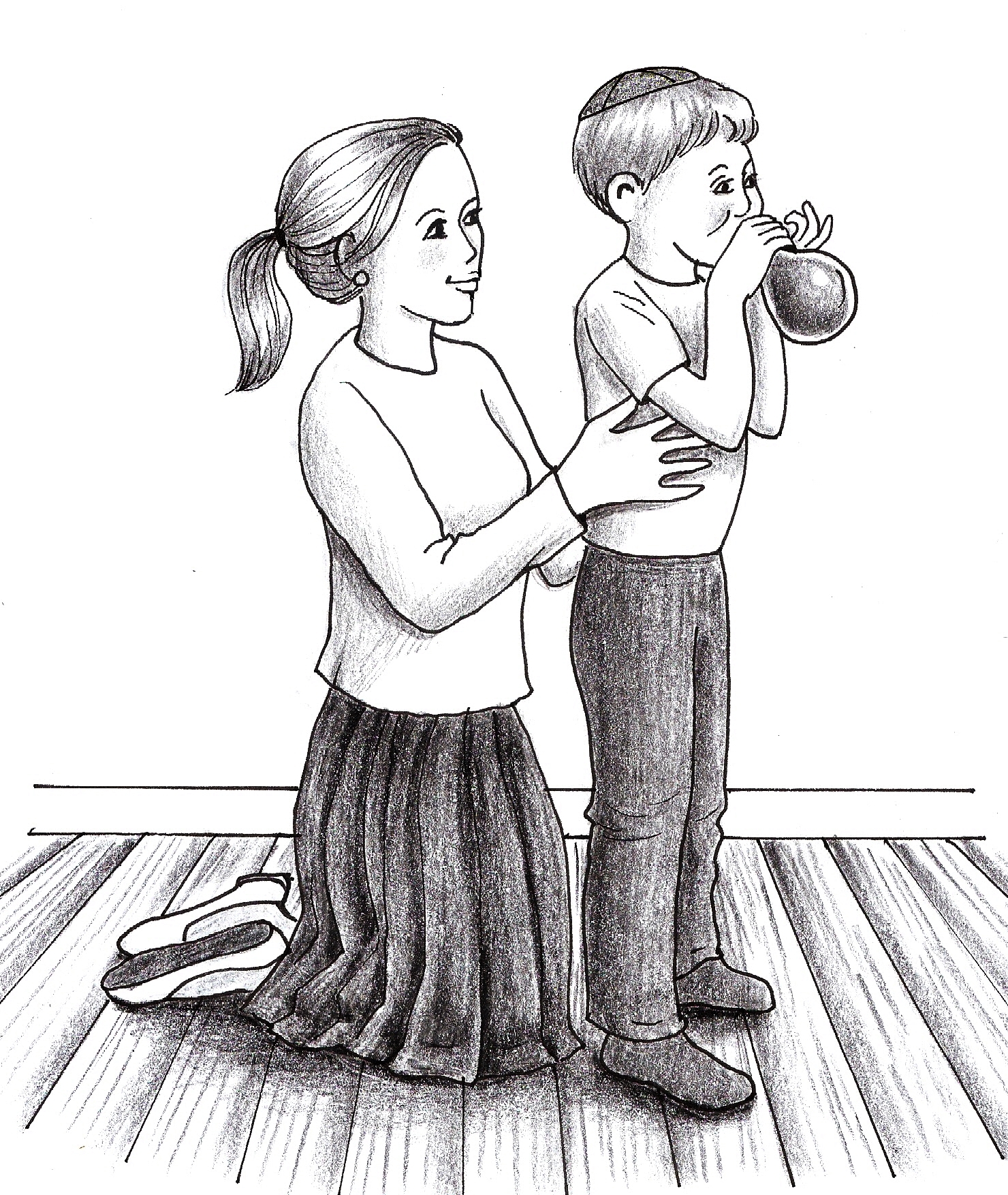
© The Parent-Child Dance. Purchase on Amazon.
Pro Tip for you: Practice during calm moments. A breathing technique or grounding tool taught in the middle of a meltdown rarely sticks. Practice it when your child is regulated, so the skill is already familiar by the time it's needed.
Making Regulation Part of Everyday Life
Families who do this well don't treat regulation as a crisis response. They treat it as a rhythm woven into an ordinary day: a few minutes of movement after school, a predictable wind-down before bed, a consistent way to check in with each other at dinner.
Regulation built this way stops being a strategy you reach for in a hard moment and becomes a baseline the whole household returns to. That baseline is what carries a family through harder moments when they come, not because the hard moments stop happening, but because everyone has more capacity to meet them.
Frequently Asked Questions
Is nervous system regulation only useful for children with a diagnosis?
No. Every nervous system, regulated or not, benefits from these tools. Children with sensory processing differences or anxiety often need more explicit, structured support, but the underlying skill is universal.
What's the difference between regulation and simply calming down?
Calming down describes a single outcome. Regulation describes a skill: the ability to move between activated, shut down, and steady states, and to find your way back. A regulated child or adult still gets activated sometimes. What changes is how reliably they return to steady ground.
How long does it take to build these skills?
It varies by child and by family, and the progress isn't linear. What I typically see is steady, gradual improvement with consistent practice: more good days woven between the hard ones, rather than a single turning point.
What if a regulation strategy doesn't work at the moment?
That's common, and it doesn't mean the tool has failed. A nervous system that's already deeply flooded may need co-regulation from a calm adult before any individual strategy can land. Return to the tool once the state has settled, rather than in that same moment.
Can adults use these same strategies?
Yes, and I'd encourage it. Every tool described here for children works for adults, too. Your own regulation is also the model your child is learning from, so building it benefits both of you at once.
References
Porges, S. W. (2007). The polyvagal perspective. Biological Psychology, 74(2), 116-143. https://doi.org/10.1016/j.biopsycho.2006.06.009
Feldman, R. (2007). Parent-infant synchrony and the construction of shared timing: Physiological precursors, developmental outcomes, and risk conditions. Journal of Child Psychology and Psychiatry, 48(3-4), 329-354. https://doi.org/10.1111/j.1469-7610.2006.01701.x
McEwen, B. S. (1998). Protective and damaging effects of stress mediators. New England Journal of Medicine, 338(3), 171-179. https://doi.org/10.1056/NEJM199801153380307